Physical rodent exclusion differs fundamentally from recurring rodenticide programs by addressing building envelope integrity rather than relying on rodent poison boxes. A rodenticide box leaves dead animals inside…
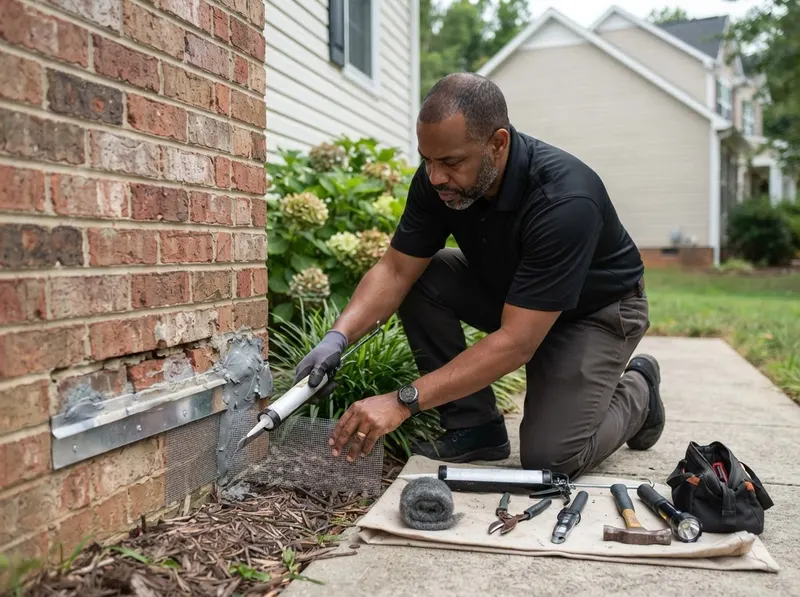
Physical rodent exclusion differs fundamentally from recurring rodenticide programs by addressing building envelope integrity rather than relying on rodent poison boxes. A rodenticide box leaves dead animals inside subfloors and wall cavities, whereas physical exclusion stops ingress entirely. When an exterior gap measures 1/4 inch or wider, a juvenile mouse can compress its rib cage to pass through. For long-term home preservation, structural exclusion eliminates the need for ongoing chemical applications near pets and children, though it requires a higher initial investment than a single trapping visit. The practical trade-off balances an upfront carpentry and installation cost against avoiding chronic crawlspace insulation contamination over multiple seasons.
Local housing stock across Mecklenburg County dictates distinct vulnerabilities. In older neighborhoods like Dilworth, Plaza Midwood, and NoDa, historic homes often feature pierced-brick foundations, deteriorated wood siding, and crawlspace vents that settle over decades, creating open runs for Norway rats. In tree-canopied zones such as Myers Park, Foxcroft, and Cotswold, mature water oaks overhang shingles, giving roof rats direct access to roof eaves, plumbing stacks, and fascia joints. Farther south in Ballantyne or north in University City, modern slab foundations frequently expose gaps around AC line-set chases, vinyl corner posts, and builder utility penetrations.
Technicians resolve these ingress vectors using permanent materials: 19-gauge 1/4-inch galvanized hardware cloth, copper mesh stuffing, heavy-gauge aluminum flashing, and elastomeric sealants. 1. A complete structure scan identifies all chew marks, greasy rub marks, and droppings from ground vents up to the roofline. 2. Field specialists seal all identified penetrations larger than 6 millimeters using gnaw-proof metals. 3. Mechanical snap traps are positioned exclusively inside attics or crawlspaces to clear any trapped interior population within 5 to 10 business days, bypassing rodenticides altogether.
Every job gets a firm, written price after a free on-site visit.
Tell us about your residential rodent exclusion job in Charlotte and we'll send a clear, written quote, usually the same day.
 Red Cedar Pest Control